


The Day the Nullarbor Awoke: A Surreal Train Journey
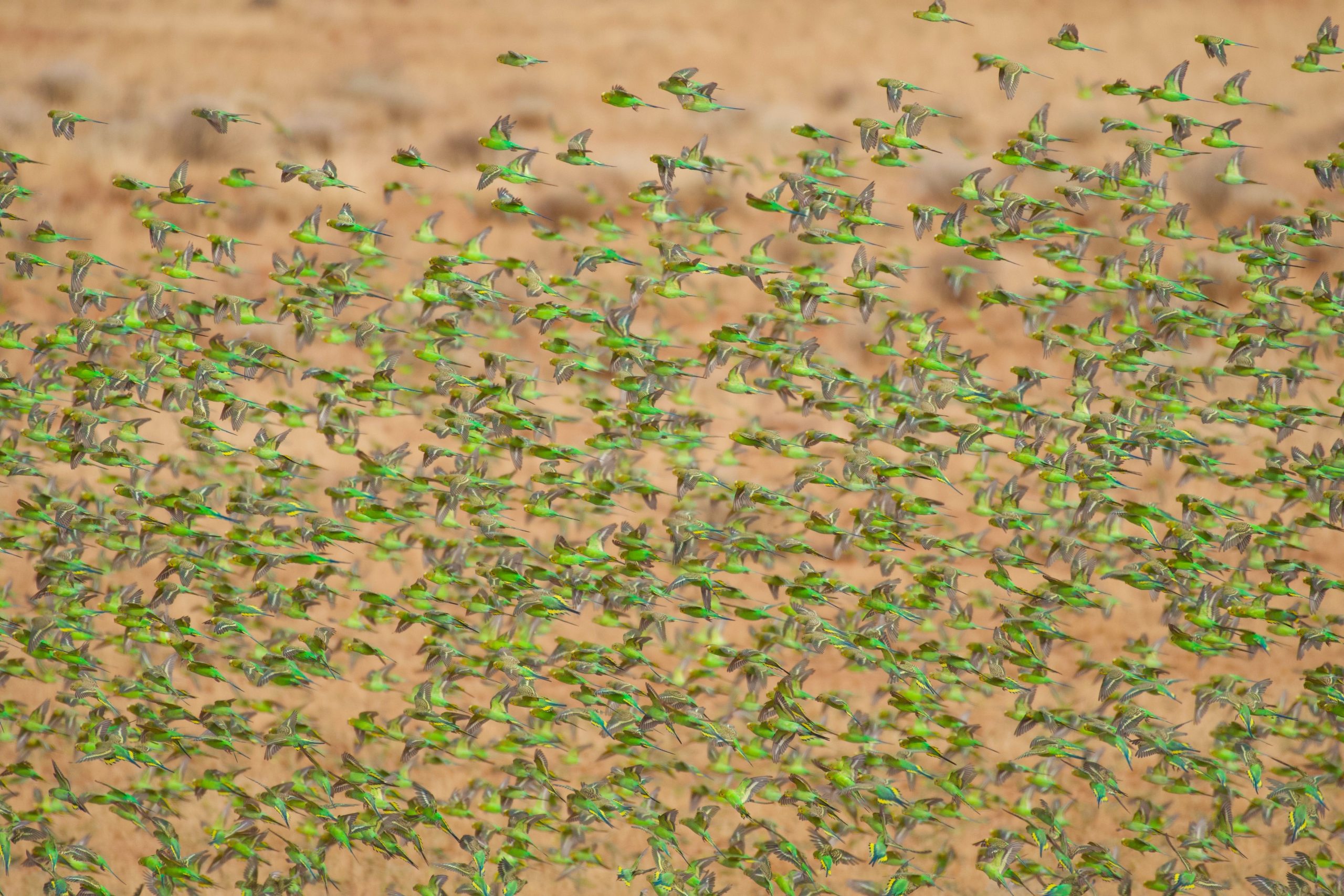
Feature photo: Thousands of Budgerigars wheel over a waterhole in the Australian Outback Photo: Michael Greenshields, Australian Geographic Travel
As the Indian Pacific train rumbled across Australia's vast, seemingly lifeless, Nullarbor Plain a green wave erupted from the desert, waking the passengers from their Nullarbor Trance
Robots nodding in unison
What weirdness had I walked into?
As I opened the door into the buffet car on the Indian Pacific train I couldn't help but notice a group of passengers standing robot-like, backs to the beer bar that ran along one side of the carriage.
Mesmerised, beers ignored, they stared out the panoramic windows on the other side of the train as the endless Nullarbor Plain hurtled past. In unison their heads nodded slightly, up and down, as if they were answering multiple questions to which the answer was a slow: “Yes”.
No-one spoke as the train sped along the longest, flattest, straightest stretch of railroad on earth — 478 kilometres of almost uninhabited plain — with the only sound being muffled “clickety-clacks” as the wheels passed over joints in the rails.
So coordinated was the nodding I thought maybe this was some communal joke to help pass the time on the 70 hour, 4,352 klm trip across Australia from Sydney to Perth. Turning to look out the window where the “robots” were staring I saw the vast flatness of the Nullarbor Plain stretched to the horizon where orange sand, mottled by grey saltbush and spinifex, intersected with the deep blue sky.
Focussing closer I realised, this was no joke — my fellow travellers had fallen into what I later named the “Nullarbor Trance”. But what caused it?
Beside the train telegraph poles flashed past, every few seconds, the wires between them rising up and down between each pole. With nothing else to look at, this group at the bar had become mesmerised by the wires, their eyes tracking them….up and down, up and down. It was one of the funniest things I’ve ever seen — but what the Nullarbor did next shocked them out of their trance.
Beer spilt in the melee
Unannounced, a huge emerald wave burst off the surface of the Nullarbor, engulfing everything.
Disturbed by the train, tens of thousands of tiny green birds rose out of the saltbush — wave upon wave — some so close I could see individuals, a tsunami eclipsing the vastness of the Nullarbor. Millions of luminous feathers flashed in the sunlight as gasps of amazement filled the buffet car.
After what felt like minutes, but couldn't have been more than a few seconds, the sparkling cloud of green wheeled away and disappeared leaving everyone on the buffet carriage animated, trying to figure out what they'd just seen. Beer was spilt in the melee — the Nullarbor Trance had disappeared!
I was in a same dilemma too, what on earth was that?
Then it dawned on me: "Budgerigars" I blurted out involuntarily whereupon everyone looked at me incredulously.
Like me, the folks in the bar of the Indian Pacific that day had only seen blue, yellow or white budgies as pets in cages.
We’d never seen real budgies in the wild and, although I’d heard about large flocks, this was my first encounter. Wild birds are a spectacular, iridescent, unforgettable green and I remember thinking: why would anyone want to breed that colour out of them?
Through the panoramic windows of the Indian Pacific the seemingly lifeless Nullarbor had shown us what Australia can conjure up out of almost nothing — the brave little Aussie budgie.
Note: this story was drawn from real life observations on the Indian-Pacific train many years ago. Travel on the train has become considerably more sophisticated than it was in 1974. Find out more here.
Other places to see "Budgies" in Australia
Budgerigars are parrots and are one of Australia's greatest nomads, moving across vast swathes of Australia's outback tracking rain and seeding plants that they live on. Huge flocks, sometimes called a "chatter", will travel hundreds or even thousands of kilometres at high speed and low elevation searching for water — how they know where to find water remains a mystery. They can appear anywhere in the arid zone. Discover more about Budgerigars from Birdlife Australia
Australian Geographic Travel conducts a number of birding and wildlife tours where you may see Budgerigars. They are:
- Birds of Channel Country Outback Safari - Queensland
- Mallee and Outback Birds of Victoria and Mungo - Victoria & New South Wales
- Island Birds & Whale Sharks & Ningaloo Reef - Western Australia
- Alice Springs to Uluru Luxury 4WD Camping Safari - Northern Territory
- Mungo Outback & Conservation Journey - Victoria & New South Wales
Threats to Budgerigars (courtesy Bush Heritage Australia)
Budgies are abundant due to the availability of artificial water sources for livestock in arid areas. Nonetheless, feral cats predate on budgies, and feral as well as native herbivores may cause local declines in their preferred food source.
Introduced pasture grasses such as Buffel Grass and African Love Grass are spreading through much of the Budgerigar’s range, replacing their preferred native grasses en masse. Inappropriate wildfires, often fuelled by introduced pasture grasses, may destroy suitable nesting hollows by burning old trees.
ABOUT THE AUTHOR
Roger Smith writes Australian Geographic’s Treading Lightly column and is Director of Conservation Travel at Australian Geographic Travel (AGT) where oversees AGT's Conservation Travel and Sustainable Tourism program. In 1992, with his partner Janine Duffy, he set up one of Australia's leading wildlife tourism companies, Echidna Walkabout Nature Tours which is now a subsidiary of AGT with Roger staying on as its General Manager
Nov 24, 2024
Read More

Birds of East Gippsland: Australian bird watching hotspot
Over the past 10 years East Gippsland has become known as one of Australia's best bird-watching locations. Located in Australia's south-eastern corner its prolific birdlife is supported by huge conflict between two mighty oceans.
Must-See Western Australia Wildlife: Link Your Adventure
Iconic is the only way to describe Western Australia’s coastal wildlife. Where can you see Numbats, Orcas, Whale sharks and Rock-wallabies?